Growing capsicum in polyhouse - my experience

hi aman !
again i would say, its VIKS :stuck_out_tongue:
yes, you are very true when you say that the bed preparation is very important and plays a very important role for a healthy plant.
i am assuming that the plantation was done april 2013, 6 months plants. honestly speaking, i do not have any knowledge about gerbera. all i know is that they are very pretty flowers :slight_smile:
but if we talk in general, all plants have the same principle, they all need same nutrients. it is only the ratio that varies crop to crop, and at what stage what nutrient should be given. floral plants will have a different needs vs vegetable crops. climbers will have different needs, fruit plants, vegetables which are basically roots or grow underground (carrot , radish, potato) will have different needs.
this is considering that certain nutrients or micro nutrients promote the growth of certain parts of the plant.
so carrot, which is a root will need more of “P” (Phosphorus) where as … umm… lets take capsicum, so capsicum has roots (obviously) then, flowering process, a steam, multiple branching, and fruiting. so the nutrient requirement will strictly depend on the crop you are planning and again would change as per the plants stage or what your aim is.

i am sure you are aware of this.

ok, so now about bed preparation. the first question that comes to my mind is why add nutrients to bed when you are fertilizing them? bed preparation is not only about nutrients.
beds are like the house of the plants… (i wish i had a better example) anyways, so how they are, what they are, will play a major role. a more comfortable environment for the roots will ensure better plant growth.

so a combination of various types of soil, manure, compost, cultures, slow releasing nutrients, chillated nutrients has to be selected depending on the crop and its nutrient needs.
mixture of different type of soil will improve the quality and promote growth for various numbers of helping cultures, which NO other media can support (water, cocopeat, perlite etc). will be mushy, have proper water holding capacity etc
the composition and selection of the basal dose and soil, should be considered depending on the crops life. if its a short term crop eg - brocolli / lettuce iceberg etc - which are ready for harvest in like 45 days, then the composition is different, for capsicum, which has a life of about an year it would be different.

to make it short and i am making points -

  • chillated nutrients are added for immediate action.
  • slow releasing nutrients are added for a continuous and slow release of the nutrients for a long period.
  • various cultures are added to grow helpful bacteria / fungus.
  • compost is added to have a proper soil humus level
  • neem cake is added for humus + nutrient
  • bone meal , blood meal is added
  • High NPK is added
  • rice husk - for mushyness and slow decay resulting in food for the helpful bacteria/culture.

and i am very glad to see your zeal, and yes, i have had my share of experience with the pesticide/fertiliser sales people :slight_smile:
and aman, all the time you have spent with your gerbera, this is a big experience in itself, which will help you life long.

this is a very long discussion, and a very important one too.
so lets keep sharing our experience and opinions.

Good day!

Vivek

1 Like

Greetings Mr.Dasharathe,
thankyou for the support.

it was exactly 4 yrs yesterday (2 oct 2013) that i got into farming.
you are most welcome to visit and stay with me anytime as per your convenience.
i must tell you, my setup is not fancy. and you will have to get your farming outfit and gear :slight_smile:

i am available throughout if you need me anytime.

looking forward to meet you soon.

Vivek

SHORT PLANTS, TALL PLANTS , UNEVEN GROWTH

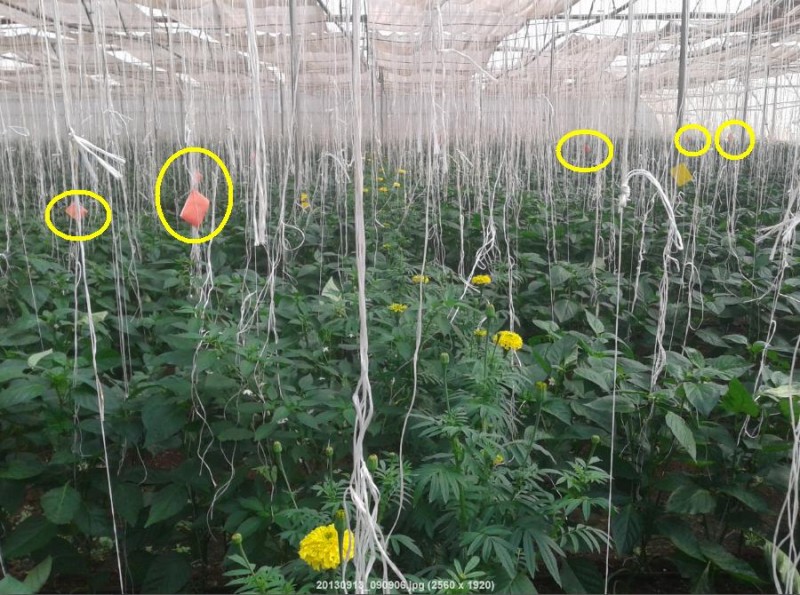
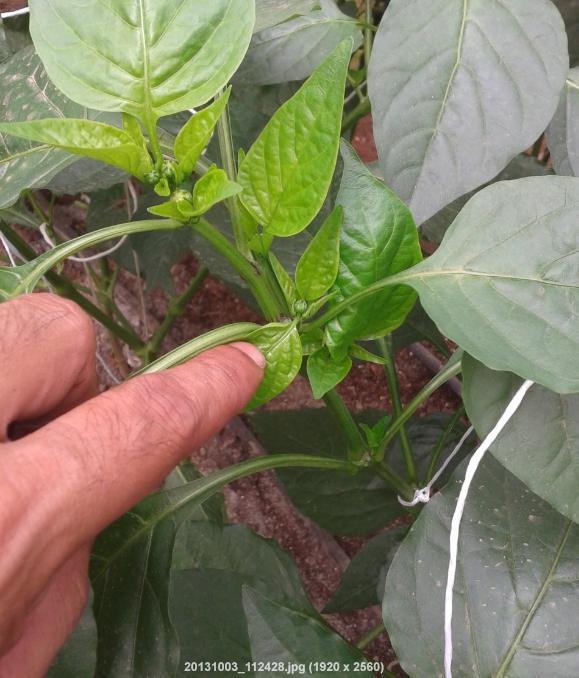
i have some uneven growth in a few pockets (attached picture 1) most plants are 4-5 feet, few are 2-3 feet. WHY??

now there are many reasons -

  • healthy seed or weak seed
  • root damage while plantation

i cant analyse the seed quality, nor do i want to pluck a plant and see the roots.

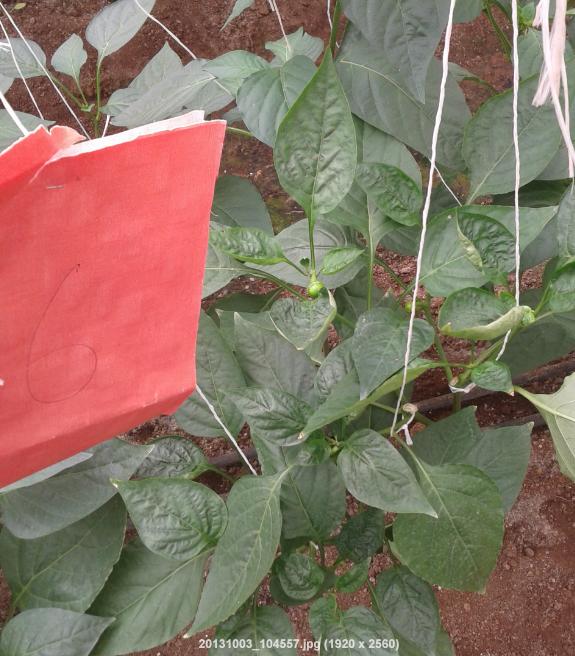
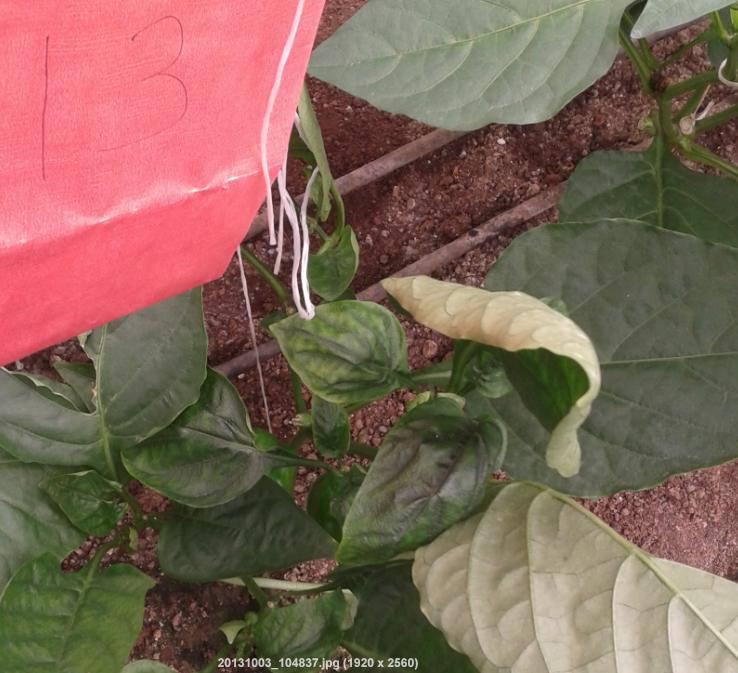
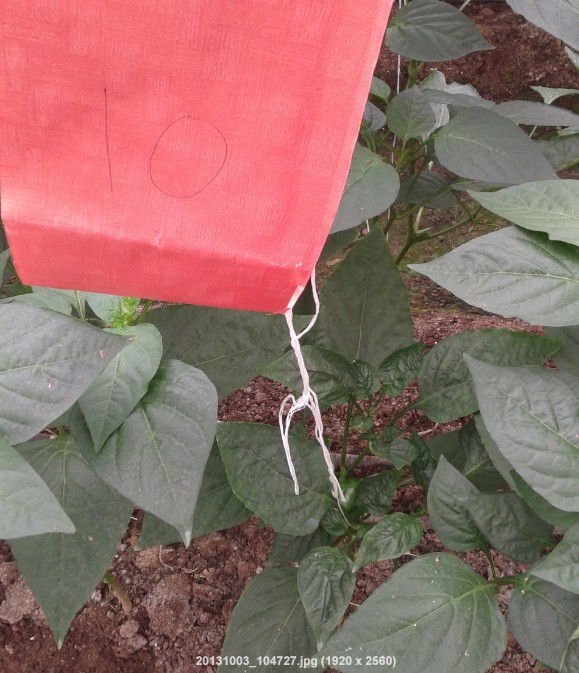
so what i do is i mark and number all my favorite plants (attached picture 2) having uneven growth , infection etc. for daily monitoring.

so now i am thinking that the uneven growth is due to improper drip discharge, as my drip system is 2 years old and i am sure it must have some blockages.
so today i have some trials for fume based drip cleaning.

lets see how it goes.

Vivek


3 Likes

hey Vivek

hope this time i got it right :wink:

It was great to see your progress on field and the depth knowledge that you have accumulated, it surely shows in your progress.

Alright, continuing our last discussion.
So, i am shifting my plants into polybags and planned to do the bed preparation properly once again. Do you have some tips for this ?

Also, as i told you earlier my two other polyhouses are empty at the moment and surely your work has inspired me alot towards capsicum farming, i would like to do it in one of those.
I will be more than grateful if you could guide me along the whole process, from the starting that is bed preparation and seedlings preparation.
weather is suitable at this time of the year, i think it would be great to go for this crop.

SUGGESTIONS and TIPS are always welcome from all of you, as i just want to learn as much as i can.
Vivek being the GURU :wink: :wink: :slight_smile:

Aman

hey Vivek

I have few more questions for you, kindly answer them at your convenience:

  1. What is correct time to start preparing for capsicum, i mean what the current time of seedlings preparation and transplantation ? what should be temp. and humidity at the time of transplanting ?

  2. Also, i saw that you are using some very good instruments for temperature, humidity, lux and ph monitoring. Can you please provide me the contact information of the vendor from whom i can procure all these ?

You suggestions/comments/tips are always welcome.

Thank you

Aman

Dear Members,

When you read a post and you feel the iformation is worth to remember and adopt in your farm, make it a point to thank the members.
This post was viewed 4000+ times and just 80 thanks! common folks let us hail the good work

Aman,
I feel you owe few thanks to Vivek. You just need to click(it doesnt cost you anything) on thank you button which available on each post.

1 Like

Dear moderator

I am new to this forum, hence i did not know about the ‘thank you’ option available. I am more than grateful to Mr. vivek.
Anyways, thanks to you for letting me know about a good feature of the forum. And i do owe him, i know it, i need not to be reminded about that.

Aman

1 Like

Aman, i am thinking wont transplanting the plants from beds to polybags, and then again to beds give a shock to the plants, cause root damage? plz note that all plants by themselves have the tendency to stop their growth for a very long time in this state.
also you will have to put in extra efforts to fertilize the plants, promote root development.

as i have told you earlier, i know gerbera for a pretty flower, but never had the opportunity to study the plant in detail. so the above is what came to my mind.
your attitude for doing experiments is what i like, do more research, discuss with growers, flower company people (altough i know we both dont trust them :p) and give it your best try. take this on priority as you are loosing on valuable resources.

do not take capsicum plantation, just cause i have. again study and do research about the crop you plan, consider the market, care it needs, resources it would need, labor it would need, local help/guidance if you may require, your experience etc

plantation time is dependent on various factors, and NONE of them are related to climate or season or anything. you can grow any crop at anytime of the year in a polyhouse. there are varieties of seeds specially suitable for polyhouse (tomatoes, okra , cucumber etc) i dono why i wrote that. oh yeaa… so if we take eg tomatoes then there are specific seeds for a certain time of the year. this will help you prevent general infestation, or better survival rate in hot weather or cold weather, wet soil, dry soil etc.
i am mixing up things here now.
ok so about time of plantation, anytime is right. PLZ study the market (price) pattern, general plantation pattern followed by other growers in your area to get an idea about the demand and price pattern. plantation should be done considering when your peak production will be against the demand and price of the crop you select.

and aman, i would love it if you call me just plain Viks :slight_smile:
we can be more like friends rather than the guru and student thing.

Vivek

Thankyou for your support sri.
i would be more glad if they could ship me gold biscuits :smiley:
honestly, as a human, it feels good to be appreciated, and encourages me all the more.

Vivek

P.S. i am serious about the gold biscuits.

2 Likes

Aman,
about the source of the instruments, i will let you know shortly.
also we have discussed lot of topics eg plantation time, very initially in the blog, so plz go through the blog from start to avoid repetition.

i do not mind repeating, but it would cause unnecessary confusions.

Vivek

Hey Viks

The option sounds good, i probably need to do a little more research. though i have done a good amount from net, but the still the practical part is left. i should go and contact the vendor and ask him about the best price seasons and everything.

Also,

Which variety/company seeds do you use ?

I am gonna do a little more research but one thing i am sure about that capsicum is the crop m gonna put in 1 polyhouse, not only because you are doing it but also coz i have heard a lot about this crop since my polyhouses were getting built.

I think its worth giving a careful try . :wink:

Take care and do send me the vendor (climate instrument) details as soon as possible.

YOUR FRIEND ( :wink:)
Aman

after my first set of fruits were completely harvested, i was concentrating on the development of new shootings, bud formation, flowering and so on… this was like 3-4 days back.
i focused the plants energy for the development of these shootings.

now i dont do any magic or woo doo for that. its pain and simple.
i have stressed throughout on the point about understanding the basics of plants. it is very simple. every element related to plants (water,air,nutrients,soil,temperature etc) have certain characteristics and have specified functions.

so talking in general about N-P-K (Nitrogen-Phosphorus-Potassium) each element (N/P/K) has a specific role to help boost certain characteristics in the plant or to focus the plants energy for a specific function (development of roots, leaves, shootings, stem thickness, flowering, growth control, formation of fruit, building of fruit - in terms of size/weight, color of the fruit etc.)

i had focused on “P” more in my last fertigation, and see the new shootings are popping out within 2 days.
have the habit to study and make observations after each measure you take. capsicum plants (most plants are, not trees) are very quick in response. so make observations on frequent basis.

continued in next post…


i have a total of 116 plants which are my favourite, and have number and marked them.
what happened with me was initially, as i told i had virus problem, i could not track the number of infected plants, nor did i know if it was spreading or under control.
i noticed few plants every time i used to take observations, as there are a total of 16500 plants, i could never remember which plant i had seen or was observing.
so i started color / number coding them based on the observations i was making in them.

eg- for curly leaves (symptoms of virus infection) i am using red, for areas with uneven growth i am using white, for plants which have leaves chomped by worms i use blue…
so now i have all the data in black and white. and i know the actual condition, if its spreading or getting worse or improving.
also color coding helps me identify pockets in my polyhouse easily which have specific problems. so i can spend more time in that region and look for the cause.

Vivek


hey Aman!
most of the instruments / gear i get for the farm are from Foggers Mart.
they are at www.foggersindia.com

details about seed variety and price i have mentioned in my earlier posts. plz check.

Vivek

1 Like

i would like to share some of my communication with gentlemen who are experts in various elements related to farming (plant health, disease resistance etc)

bits of mail received

I know I may be speaking Latin for you, and that some of my statements must be contrary to your commercial practices and beliefs.
But, I am speaking science based on molecular mechanisms.
Science that is just beginning to come in practice in the most advanced research work in agriculture.
So I am opening up with the thought process which I think is key to the success in agriculture.

We are right now over dependent on nitrogen fertilizers.This is not good. Remember all life forms need carbon and nitrogen.
A tired man will always prefer a drink having sugar (carbon) over meat/egg/sweets made up of milk or dal (high nitrogen - difficult to digest). Same id true with soil as well as plants. But we ignore this.
At this point in time I suppose you are trying to go ahead using principles of “industrial method of farming”.
But this will take you away from nature.
I will give you one analogy.
You are trying to build your plants just like a professional body builder. He uses high nutrients and steroids, and you use heavy doses of chemical fertilizers and synthetic growth promoters.
Does this body builder ever grow though to withstand any natural shock?
Doesn’t he suffer from uncommon complications such as renal failure, liver problems etc.?
In the same, by trying to provide more inputs you are weakening your crop and making it more and more dependent on your inputs.
When you yourself have limited knowledge of plant needs, it is obvious that you will not be able to meet the exact demands of the plants every time and end up with some problem and more so economic losses.

My Response to the mail

I have already mentioned and accepted that i was concentrating on nitrogen (not that I don’t give other nutrients) this was majorly with a purpose which I have told you earlier.
All my fertilizers (basal dose, day to day fertigation, drenching etc) schedule is STRICTLY purpose based.

I have huge amount of bank loan on me. So my purpose is very clear and well defined. As a basic rule of any business, I need to make the maximum from my limited resources.

That is my goal #1 honestly. I have had the habit to do experiments at my level, and document them. So while the experts were working in their lab, under fluorescent light, I was doing my little experiments under the sunlight, in the actual environment. I will tell you one thing, conducting experiment on plants in a lab or somewhere across the globe is different, and doing live experiments on the actual farm, having thousands of plants is totally different. There are n number of variables in the actual farm where the plants will be actually grown.

A simple example would be say, automobiles, manufacturers conduct various tests, spend millions on infrastructure and tests, analysis, various trials before launching a vehicle in the market, yet there are manufacturing claims, malfunction.

I am considering every individual plant as a production unit and I know my plants life is about 360 days, out of which 75 days are gone (20%)

And yes, you are again right, that I am treating my plants like professional body builders, but that does not necessarily mean that I am using high doses of chemical / synthetic fertilizers.

Your point of view is acceptable and I agree to it. But then I have different strategy. I am practicing the “self-resistance concept” for long term plants, I have a mango farms and wineyard, these plants/trees are going to be with me forever. So for them I have a different strategy.

My target is to streamline all the necessary elements at each stage of the plants (capsicum) life. And control them for maximum output, that does not mean I am neglecting the health of the plants. Most of my foiler sprays / irrigation are for the benefit of the plant in terms of health and resistance building. I have a weekly foiler spray for making the plants more resistant to diseases/infection and promote natural growth (plz note these are 100% organic sprays)

Right now, my plants are young, and they do not need high dose of fertilizers or need to be pushed. So the fertigation will be light for another 2 months or so.

I have crossed the 3 ton benchmark in my first set of harvest. And targeting a minimum on 8 times for my second.

My plants are not like the regular 2-3 shoot, 10-30 fruit plants, they are more than that. So its obvious they have more appetite as compared to a regular plant.

The point is, as the life ages and as more shoots, fruits will be on the plant, yes I will increase the dose of my fertilizers, and push for them if I have to. Cause that’s my target.

I work on the basis of a flow chart, which is very simple. I have listed down what the plant needs and/or does at each stage of life. For example, after the saplings are planted, it is stupidity to promote fruit growth. What needs to be focused on is root development. After 20 days, I will not focus on branch development or flower development, but I will focus on development of big leaves and stem, after 30 days, I start promoting flower development and not root, then fruit size and not leaves and so on..
This does not mean i pay 0% attention to other elements while I am focusing on a single factor.
This was one part, the second is about health, infestation, diseases, resistance etc. my way of working is again different here.

Talking specifically about “resistance” i divide it into two parts.

  1. Resistance via natural methods, meaning in which the plant develops the immune system etc.
  2. Create artificial barriers (doesn’t really fall under the category of resistance)

Now again, I would say that resistance which you are talking about, how do I measure it ? How do I know it works? I do not have any knowledge about genetics as a farmer. But I am sure that the natural barriers I create do not allow the media (fungus/pests etc) to get in contact with the plant. So there are less chances of catching / spreading of the infestation.

Second part is, I am up to date on daily basis about the conditions in and around my polyhouse. All my projects are live projects. So I know what exactly Is happening in and around my polyhouse. Also I know what conditions promote or are favorable for a certain type of pest or fungus (which are the carriers) so I take preventive actions immediately. When I say immediately, I mean it !

We both have lots of common and a few different targets (you as research professional and me as a farmer) and different way of working, like every individual.

Vivek

1 Like

Hi vivek,
My name is vijayakeerthy from tamil nadu ,i saw your post relay very nice work ,i have few doubt please clarify me
1.i am new to this field ,i am going to start polyhouse in tamil nadu (near chennai) for cultivate capsicum please tell me what is the minimum and maximum yield can get from 1 acre
2.i heard like this from 1 acre can get 60 ton/year is it true?
3.What is the market price i can get for 1 kg capsicum.

M.V.K
9038936834.

Greetings Mr.Vijayakeerthy,

Getting yield is totally dependent on crop health.

about figures, i have heard various myself.
quantity i could get was 7.3 kg/sq mtr (A-Grade - fruit above 220 gms) and 1.2 kg/sq mtr (B-Grade - fruit ranging from 170-200 gms), i do not consider C grade (fruits below 130 gms) into calculations.

i have a live project which is about 70-80 days young, details you would again find in my earlier posts, so from this plantation, i have crossed 3 ton with my first set of fruits (first full harvest).
about maximum, i again cant say as it is too early.

my first plantation had limitations (mainly water), so was my knowledge, exposure and involvement in daily activities.
this time i am 100% committed and feel safe about availability of water.

my target is to cross the 25 ton target in my second set of harvest.

market price for 1 kg capsicum would entirely depend on the quality of your produce which are further indirectly / directly related to the market you are catering, your location, value addition (if applicable) etc.

i have more exposure of the Mumbai, Nasik vegetable market. these are all in Maharashtra. so Rs 90/kg was decent as an average for good quality produce to me.

i will tell you a golden rule. it is very simple and we all know it. i never practised it up till now. price is affected by demand and supply and everything we know. so i study the demand pattern, the growing pattern in and around my location (the supply pattern) for capsicum when i am targeting the local market.
this helps me to be prepared when the demand will be less, but once the market is open, there is no stopping me.

Mr.Vijayakeerthy good quality will ALWAYS get better rate, no matter what the demand is.
to some extend, you can also get better rates with higher quantity.
this is very contradictory.
i will give you live example. i sell 10 kg of capsicum in my neighbour hood for Rs.200/kg
but if i sell the same quantity to a supplier in mumbai, i wouldnt get even half. on the other hand, my neighbour hood will not consume all of my 1000 kg harvest.

so having different strategies are beneficial and i can be prepared, so things dont come as a surprise to me.

Vivek

Beautiful location.Did you say it is 72 acres in total ? What is the climatic and soil conditions there? Is there a place for other growth media for polyhouses to minimise the risk of infestations? I am sure there must be cost implications.I come from a place in south where the temp touches 47 to 49 degrees.And surprisingly!!! There is power shortage.will these be a limiting factor for polyhouses.Do you have the same issues in your part of the country and how do you overcome.

Apologies if it has been covered else where in which case just tell me off

Hi Viks

Ignore me I found answers in previous posts for most of the queries I posted above.