Mr. Prabhu,
To answer your query, there is a possibility to drill further after preventing the Air-loss at the fractured zone by adding the “Drill Mud” diligently.
Drilling Mud is used to -
-
Prevent cuttings from rapidly settling while another length of drill pipe is added (if cuttings drop too fast, they can build up on top of the bit and seize it in the hole)
-
create a film of small particles on the borehole wall to prevent caving and to ensure the upward-flowing stream of water does not erode the adjacent formation.
-
Seal the borehole wall to reduce fluid loss i.e. minimizing the volumes of drilling fluid - Water.
Drilling Mud is a Bentonite Clay that has particularly useful characteristics; it can absorb many times its weight in water. It is useful in drilling wells because water mixed with bentonite tends to coat the wells of the hole and keep it from collapsing.
When you add bentonite to the water two things happen -
a) The water gets thicker and b) the sandy / collapsible walls of the hole solidify to a degree. Both are very helpful in drilling.
Bentonite for drilling comes in a very , very, fine powder. It will likely be the finest powder you will ever see. It is kind of tricky to mix into water. If the driller is not careful it will simply clump. Many a times simply pouring it down the drill pipe is successfully done but I strongly suggest thoroughly mixing it first to improve the performance.
To mix the bentonite, set up a 20 litres bucket near the drill site. Put about 11 litres of water in a 20 litres bucket and pour in the bentonite while you are mixing with a drill and concrete mixing bit. Pouring in the bentonite powder as you are mixing is much more effective than pouring the powder in and then mixing. Add bentonite until it the mix thickens but is still easy to pour. If you add too much it will get hard to pour.
Drill with Cement Mixer Bit
Drill Ready to Mix Bentonite
It is important to keep the Mixer Running while Adding Bentonite
After you get it mixed, you need to get it in with the drilling fluid going down into your hole.
Drill Head with Valve to add Bentonite
For Easy insertion of bentonite mix -
- Take the drill head off.
- Pour the bentonite mix down the drillpipe. You’ll probably need a big pitcher because it is hard to pour directly from the 20 litres bucket.
- Put the drill head back on and turn the water back on.
Then start twisting the drill pipe back and forth and working it up and down in the normal manner.
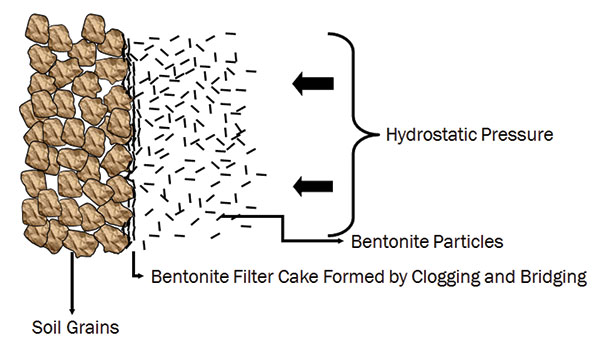
Bentonite clay additives create thicker wall cakes, penetrate the aquifer and may lesson flow in the near well area unless thorough well development is done to insure the break down and removal of bentonite drilling fluid residues.
After the Bentonite Wall cake is developed at a particular zone in the water well, the further drilling may be carried on with the following rock roller bits to remove the rock core easily upto certain depth below the bentonite sealing to avoid any fractures in the sealed portion.

Rock Roller bits for different kind of Rock strata
However, Before making any decision on well development methods or procedures, it is necessary to check on the exact situation that exists in the zone that is to be developed.
The overriding considerations are -
- the cost of the development techniques being considered and the relationship between these costs and value of well.
- The Time available.
- The availability of required Tools, equipments and materials.
- The probability of getting the desired water yield from the borewell.
- The risk of getting the desired yield from the borewell or loss of yield.
I hope this would help you in understanding the possibility of drilling further & considering the options for taking an appropriate decision for your water well.
May you have any further queries, please feel free to contact us.
All the Best !
Regards,
YASH D SHAH
(08652810004)